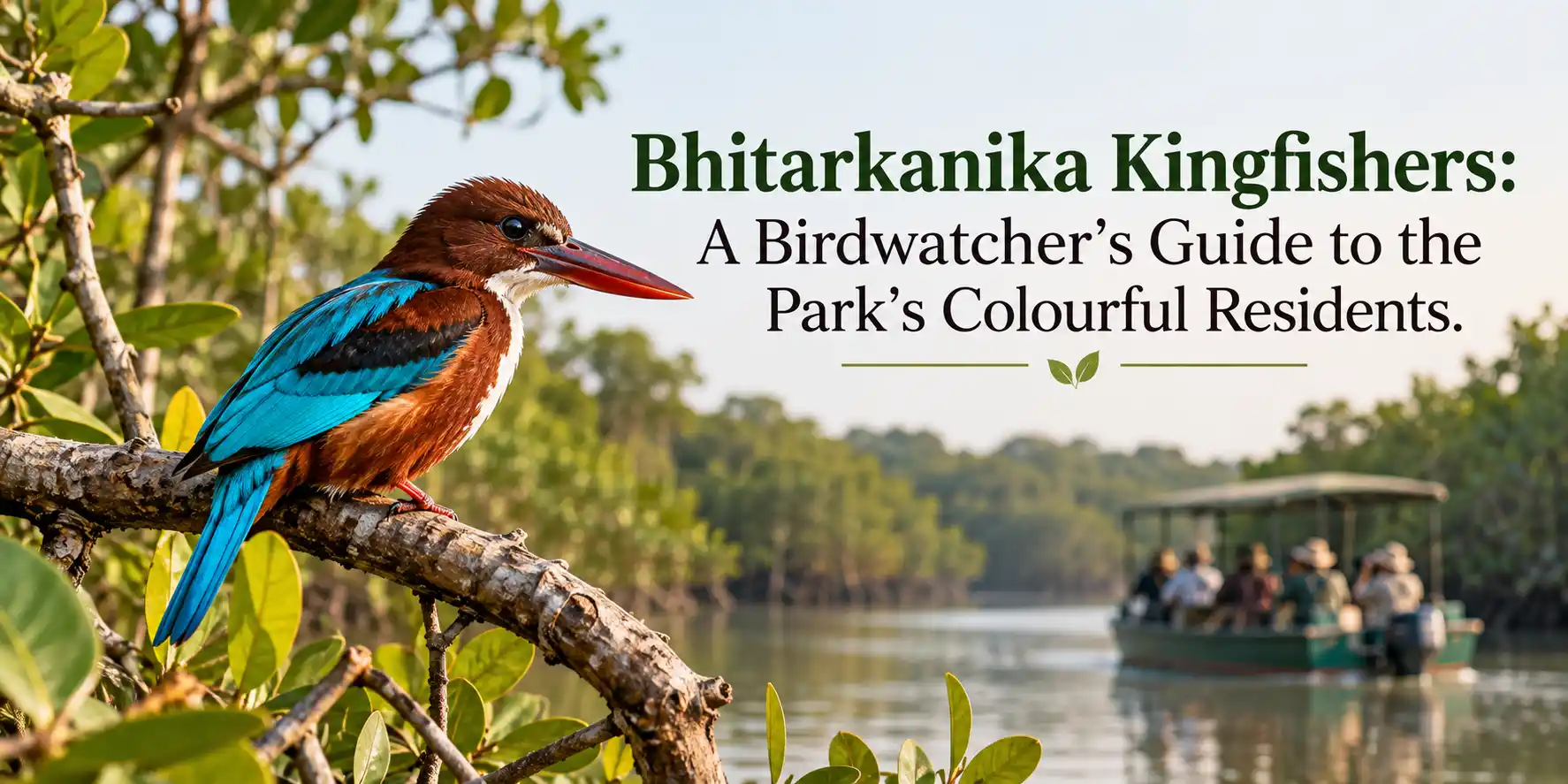
Eight kingfisher species have been documented in the mangrove forests of Bhitarkanika: the Common, Collared, White-throated, Pied, Stork-billed, Black-capped, Brown-winged and Ruddy Kingfishers. Their presence makes the region particularly interesting for birdwatchers because these birds differ in size, plumage, feeding behaviour and preferred habitat.
What makes Bhitarkanika special is not simply the number of kingfishers recorded here. The landscape combines tidal creeks, mangrove-lined banks, wetlands and stretches of relatively fresh water. Each offers different conditions for birds looking for fish and other prey.
The key to kingfisher spotting in Bhitarkanika is learning what to look for and understanding where different species are likely to be found. Eight documented species does not mean all eight will appear during a single boat trip.
Why Is Bhitarkanika Known for Kingfishers?
Bhitarkanika is known for its mangrove ecosystem, tidal waterways and rich wetland birdlife. Odisha Tourism reports more than 271 recorded bird species in the region, while research by the Wildlife Institute of India identifies eight kingfisher species associated with its mangroves.
This diversity is easier to understand when you consider the landscape. Some kingfishers hunt beside open water, while others use mangrove creeks and wooded banks. Differences in water depth, current, vegetation and available perches can influence where a bird feeds and whether an observer can detect it.
A Wildlife Institute of India study by Joli Borah, Bivash Pandav and G. V. Gopi examined the occupancy and feeding behaviour of kingfishers in Bhitarkanika’s mangroves. The researchers found differences in foraging behaviour and prey characteristics among the four species studied in detail. Their findings help explain why several similar-looking birds can share the same broad environment while using its resources differently.
You can explore the wider habitat in our guide to Bhitarkanika’s mangrove ecosystem.
The Eight Kingfishers of Bhitarkanika
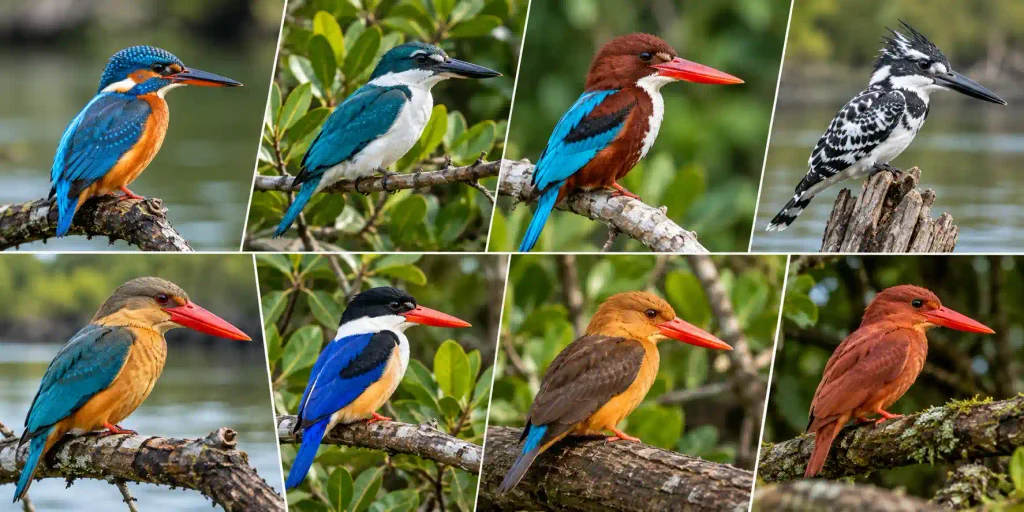
The following eight species are documented in research on the Bhitarkanika mangroves. The identification notes below focus on visible field marks and habitat clues; they are not a guarantee that a particular bird will be present at a given location.
1. Common Kingfisher (Alcedo atthis)
The Common Kingfisher is a small, brightly coloured bird with vivid blue upperparts and orange underparts. Its compact size and quick, low flight can make it easy to miss when a boat passes through a creek.
Look for it perched close to the water, watching for small fish before making a sudden dive. Compared with the larger kingfishers, it appears more delicate, with a relatively slim body and a narrow bill.
What to look for: A small blue-and-orange bird sitting quietly near water or darting rapidly along the water’s edge.
The Common Kingfisher is a useful species for learning the basics of bird identification because its combination of size and colour helps distinguish it from the larger birds in this group.
2. Collared Kingfisher (Todiramphus chloris)
The Collared Kingfisher is strongly associated with coastal habitats, including mangroves and tidal creeks. It has blue-green upperparts, a dark facial mask and a contrasting pale collar around the neck. The exact shade can vary with light and subspecies.
Unlike the Common Kingfisher, the Collared Kingfisher is a more robust bird that often watches its surroundings from a branch or exposed perch near the water.
A Wildlife Institute of India study found seasonal variation in its occurrence in Bhitarkanika’s mangroves. In that study, the Collared Kingfisher was more abundant during the summer survey period. These are findings from a specific field study, not a guarantee of present-day abundance or sightings.
What to look for: A blue-green kingfisher sitting on a mangrove-side branch, with a dark eye stripe and a pale collar.
3. White-throated Kingfisher (Halcyon smyrnensis)
The White-throated Kingfisher is one of the easier species to recognise by its strong colour contrast. It has a rich brown head and body, bright blue wings and back, a white throat and a heavy red bill.
Although its name suggests a close association with water, it also uses a variety of open habitats. In Bhitarkanika, the most useful identification clues are its size, red bill and distinct white throat against the brown plumage.
Its bright blue wings can be particularly noticeable when it takes flight.
What to look for: A relatively large kingfisher with a brown body, white throat, blue wings and a prominent red bill.
Don’t rely on colour alone in poor light. Size, bill shape, posture and the bird’s surroundings can help confirm what you are seeing.
4. Pied Kingfisher (Ceryle rudis)
The Pied Kingfisher stands out because it is patterned in black and white rather than the familiar blue and orange. It has a short, bushy crest and a dark bill. One of its best-known hunting behaviours is hovering above the water before diving towards prey.
Pied Kingfishers are associated with a broad range of waterside habitats, including estuaries and mangroves. In Bhitarkanika, waterways with relatively fresh water may offer useful opportunities to look for this species.
What to look for: A black-and-white kingfisher perched over water or hovering in place while hunting.
Its hovering behaviour is a particularly helpful field mark. If you see a bird suspended above the water before plunging down, the Pied Kingfisher is worth checking.
5. Stork-billed Kingfisher (Pelargopsis capensis)
The Stork-billed Kingfisher is a large, powerful-looking bird with a disproportionately heavy scarlet bill. Its head is olive-brown, its upperparts are greenish-blue, and its underparts are buff-coloured.
Its size and bill make it easier to distinguish from smaller kingfishers once you get a clear view. It typically uses rivers and larger water bodies with vegetated banks, where it can watch the water from a suitable perch.
What to look for: A large kingfisher with a massive red bill, brownish head and blue-green upperparts.
If you are observing birds from a boat, scan prominent branches and vegetation along the bank rather than looking only at the water surface.
6. Black-capped Kingfisher (Halcyon pileata)
The Black-capped Kingfisher is notable for its dark cap, contrasting white collar and bright blue wings. The combination of a dark head and vivid plumage makes it one of the more distinctive kingfishers to identify when the bird is clearly visible.
A Wildlife Institute of India study reported seasonal variation in this species’ occurrence in Bhitarkanika and found it more abundant during the winter survey period than during summer. This is a research finding from the study period, so it should be treated as a useful ecological clue rather than a current sighting forecast.
For winter visitors interested in birdlife, this species is one to keep in mind when scanning mangrove-side perches.
What to look for: A kingfisher with a dark cap, pale collar and conspicuously blue wings.
The dark cap is the most useful first clue, especially when the bird is perched and the back and wings are visible.
7. Brown-winged Kingfisher (Pelargopsis amauroptera)
The Brown-winged Kingfisher is particularly relevant to Bhitarkanika because it is associated with coastal habitats such as mangroves and estuaries. It is a large, chunky kingfisher with orange-toned underparts, dark brown wings and a heavy scarlet bill.
A bright blue-green patch on the rump can become more obvious when the bird flies. This combination of a large red bill and dark brown wings helps distinguish it from other large kingfishers.
Unlike birds that frequently hunt around open water, the Brown-winged Kingfisher is strongly associated with coastal mangrove environments.
What to look for: A large orange-toned kingfisher with dark brown wings and a striking red bill, particularly around mangrove creeks.
If this species is a priority for your trip, tell your birding guide beforehand so the route and observation time can be planned appropriately. A sighting should never be treated as guaranteed.
8. Ruddy Kingfisher (Halcyon coromanda)
The Ruddy Kingfisher has rusty-orange or reddish-brown plumage and a thick red bill. Its overall colour is quite different from the blue-backed kingfishers more familiar to casual observers.
It can be difficult to spot because it is shy and may remain in shaded, densely vegetated areas rather than sitting in the open. A flash of colour through the vegetation may provide only a brief view.
Local species accounts describe it as an uncommon or rare visitor in Bhitarkanika. Treat it as a possible sighting, not a species to expect on every trip.
What to look for: A largely rusty-orange kingfisher with a heavy red bill, especially around shaded waterways and dense vegetation.
Because a brief glimpse may not be enough for confident identification, record the location, date and any visible features instead of assuming every reddish bird is a Ruddy Kingfisher.
Why Do Different Kingfishers Share the Same Mangrove Habitat?
The presence of eight kingfisher species in one broad landscape raises a useful question: how can similar birds coexist without all competing for exactly the same food in exactly the same places?
Research by the Wildlife Institute of India examined this question in Bhitarkanika. The researchers studied the Common, Collared, Black-capped and Brown-winged Kingfishers, looking at habitat occupancy, foraging behaviour and prey characteristics.
The study found that factors such as creek width, water depth, current, turbidity and habitat type influenced occupancy or detection for different species. It also found differences in prey characteristics, foraging substrate and foraging distance among the four species examined.
For a birdwatcher, this has a practical implication: don’t scan every part of the creek in the same way.
A small kingfisher perched close to the water, a large bird sitting on a branch over a wider channel and a black-and-white bird hovering above open water may be using different parts of the habitat.
Learning to read those differences makes observation more rewarding than simply ticking species names off a list.
Where Should You Look for Kingfishers in Bhitarkanika?
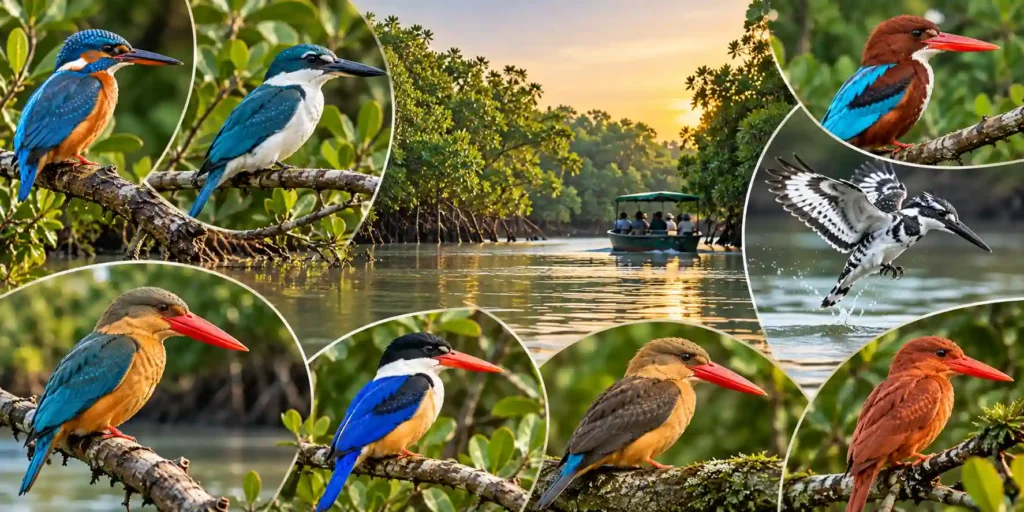
Kingfisher spotting in Bhitarkanika is best approached as a search across suitable habitat, rather than a promise of sightings at one particular point.
Mangrove-lined creeks
Watch branches and exposed perches along the edges of tidal creeks. Collared and Brown-winged Kingfishers are particularly relevant to this coastal habitat.
Open stretches of water
Scan the water surface, low branches and exposed banks for birds watching for fish. Pied Kingfishers may also hover over water while hunting.
Wider river channels
Larger water bodies with vegetated banks can provide perches for larger species such as the Stork-billed Kingfisher.
Freshwater-influenced sections
Different kingfishers use different kinds of waterways. A route passing through varied habitat may offer more opportunities than looking repeatedly at one identical creek section.
The Wildlife Institute of India’s research underlines the role of water conditions and habitat structure in kingfisher detection. However, specific sightings depend on the route, season and conditions during the trip.
Bhitarkanika is primarily explored by boat, so read our guide to boating in Bhitarkanika before planning a wildlife-focused visit. Actual access and routes should always follow current forest department rules.
When Is the Best Time for Kingfisher Spotting in Bhitarkanika?
There is no single month that guarantees all eight kingfisher species. Seasonal presence and detectability vary by species.
In its 2011 field study, the Wildlife Institute of India recorded seasonal differences for the Collared and Black-capped Kingfishers. The Collared Kingfisher was more abundant in the summer survey period, while the Black-capped Kingfisher was more abundant in winter.
These findings are useful context, but they are not a current forecast. Local abundance can change, and a bird may be present without being detected during a short boat trip.
If you are planning a visit primarily for birdwatching:
- Ask your guide what has been seen recently rather than relying only on old sighting reports.
- Check current park access and seasonal restrictions before confirming dates.
- Allow enough time to observe quietly rather than rushing between attractions.
- Keep notes on location, habitat, date and identification features.
For a broader overview of bird habitats across the destination, see our guide to Bird Watching in Bhitarkanika.
How to Identify Kingfishers Without Confusing the Species
A quick flash of blue or red is not always enough to identify a bird confidently. Use several clues together.
Start with size. Is the bird tiny and compact, medium-sized, or large with a massive bill?
Check the pattern. A black-and-white body suggests the Pied Kingfisher, while a dark cap and white collar may point towards the Black-capped Kingfisher. A rusty-orange body suggests a different identification path, but should be checked against other features.
Look at the bill. The Stork-billed and Brown-winged Kingfishers have large, heavy bills. The Common Kingfisher appears much smaller and more delicate.
Observe the habitat. Is the bird beside a tidal creek, perched over a wider channel, or hovering above open water? Habitat can narrow the possibilities, but it should not be used as the only proof.
Take a photograph when practical. A clear image can help with later identification, especially when plumage colours look different in shade or changing light.
For a reliable record, note the bird’s behaviour and location as well as its colour. Even experienced birdwatchers sometimes leave an observation unidentified when the view is too brief.
Responsible Birdwatching in Bhitarkanika
The quality of a birdwatching experience depends partly on how little the observer disturbs the birds.
Keep these practices in mind:
- Follow the instructions of your authorised boat operator or forest guide.
- Remain within permitted visitor areas.
- Avoid shouting, sudden movements and attempts to force a bird into view.
- Do not approach nests, disturb vegetation or try to attract birds with food.
- Avoid playing bird calls to draw birds closer, particularly near nesting areas.
- Use binoculars or a camera zoom rather than trying to approach a bird.
- Never leave a boat or enter restricted areas for a better photograph.
These practices are particularly important in mangrove habitats, where a quiet observer is more likely to notice natural behaviour than someone trying to get a close encounter.
How to Plan a Bhitarkanika Birdwatching Trip
Start with your birdwatching priorities. If kingfishers are the main focus, tell your guide that you want time to observe creek edges, perches and different water conditions rather than simply moving from one tourist stop to another.
A short visit can introduce you to the mangrove habitat, while a longer stay gives you more flexibility to explore different routes and additional wildlife sites. Neither duration guarantees that all eight species will be seen.
For a first-time visitor, our Bhitarkanika wildlife trip guide explains the broader experience, while Places to Visit in Bhitarkanika can help you understand the wider destination.
When choosing a stay, consider how your accommodation fits the planned route, boat schedule and travel time. That can help you spend more of the trip observing wildlife rather than rearranging logistics.
Final Takeaway
Bhitarkanika’s kingfishers are interesting because they show how much variation can exist within a single bird family sharing a connected wetland landscape.
The Common Kingfisher is small and colourful. The Pied Kingfisher is recognisable by its black-and-white pattern and hovering hunting style. The Stork-billed Kingfisher is much larger, while the Brown-winged Kingfisher is closely associated with coastal mangroves. The Collared, Black-capped, White-throated and Ruddy Kingfishers each bring their own identification clues and habitat preferences.
The most useful birdwatching skill is not memorising eight names alone. It is learning to combine plumage, size, bill shape, behaviour and habitat when identifying a bird.
Give yourself time to watch the creek edges, keep a careful record of what you see, and treat every sighting as an observation rather than a guarantee. That approach will make a kingfisher-focused visit to Bhitarkanika more rewarding—and more respectful of the habitat that makes these birds possible.
People Also Ask About Bhitarkanika Kingfishers
1. How many kingfisher species are found in Bhitarkanika?
Eight species have been documented in research on Bhitarkanika’s mangroves: Common, Collared, White-throated, Pied, Stork-billed, Black-capped, Brown-winged and Ruddy Kingfishers.
2. Which kingfishers are found in the Bhitarkanika mangroves?
The recorded species include both small, fish-catching birds such as the Common Kingfisher and larger species such as the Stork-billed and Brown-winged Kingfishers. They differ in plumage, size, feeding behaviour and habitat use.
3. Where can I spot kingfishers in Bhitarkanika?
Look along authorised boat routes through mangrove creeks, near vegetated banks and around suitable stretches of water. The best locations for a particular species depend on habitat, season and current conditions.
4. When is the best time to see kingfishers in Bhitarkanika?
The best period varies by species. A Wildlife Institute of India study found seasonal differences between Collared and Black-capped Kingfishers, so birdwatchers should check recent local sightings rather than assume all eight peaks in the same month.
5. Why is Bhitarkanika good for kingfishers watching?
Its combination of mangrove forests, tidal creeks, wetlands and varied waterways creates different feeding and perching habitats. This variety helps explain why several kingfisher species are recorded in the same wider landscape.